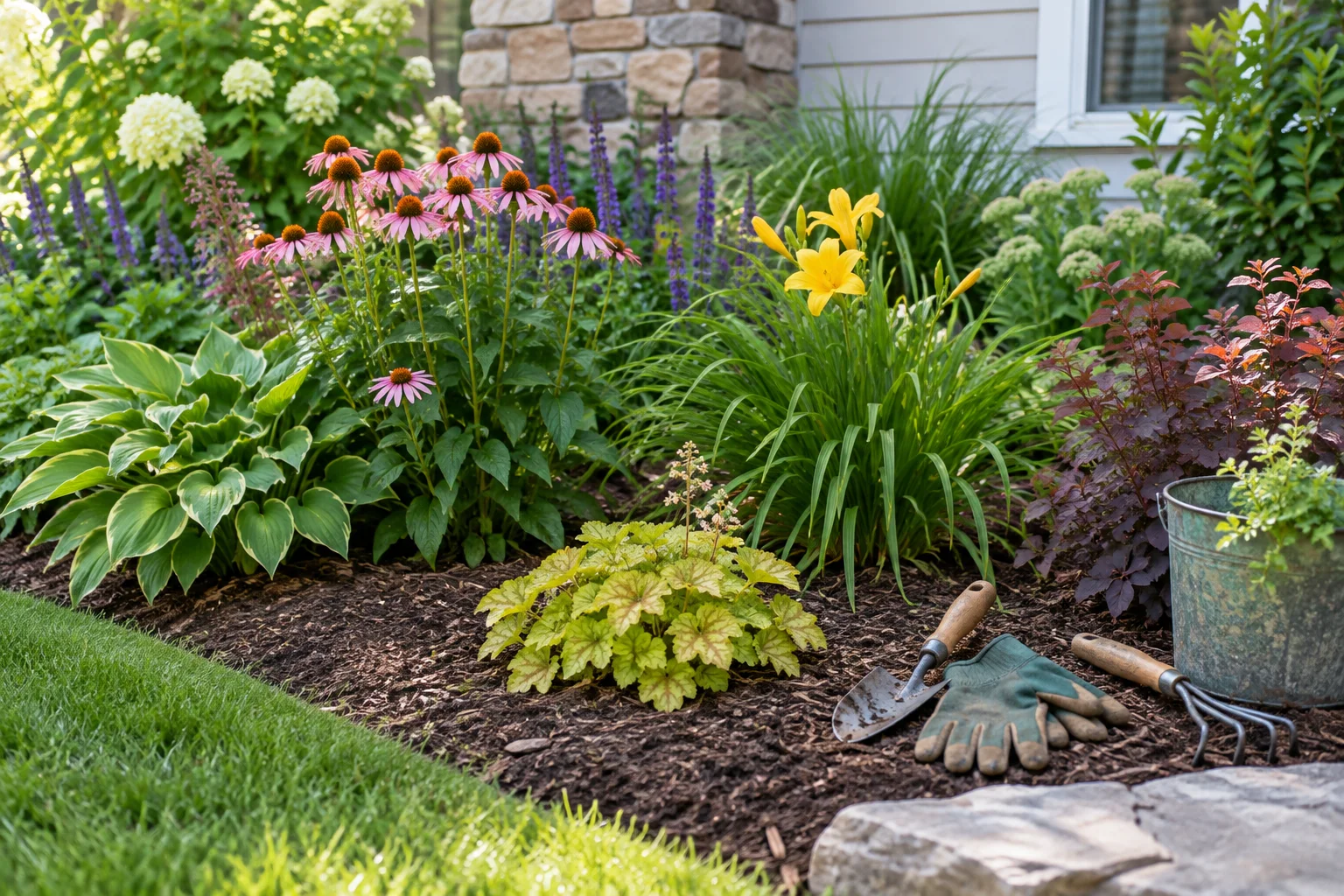
Low-maintenance planting begins with a clear idea of the work you want to reduce. One household may dislike weekly mowing, another may struggle with watering containers, and another may want fewer plants that need careful seasonal attention. A garden cannot be judged easy to maintain without knowing whose time, energy and preferences it is meant to fit.
The aim is a planting area whose routine you understand and can sustain. That usually means making choices about location, scale, access and plant behaviour before choosing colours. This guide helps you define a realistic brief and avoid replacing one demanding garden arrangement with another that merely looks simpler on installation day.
Describe the work you want to avoid
Make a list of tasks that currently feel burdensome. Be specific: dragging a hose across the driveway, trimming around tiny lawn islands, identifying seedlings in a crowded bed or cutting a hedge several times a season. A specific complaint points towards a design decision more clearly than a general wish for less work.
Then list the tasks you enjoy or would willingly keep. You may like planting a few seasonal pots but dislike maintaining a large mixed border. You may enjoy light weeding while finding heavy material handling difficult. There is no need to eliminate every garden task if some of them are part of the pleasure.
Use those two lists when speaking with a designer or provider. They make the brief personal without requiring specialist vocabulary. “I want to stop carrying watering cans down these steps” is a concrete design problem. “I want something effortless” is too broad to guide a reliable proposal.
Match the plan to your real availability
Estimate the time you can give during an ordinary busy week, not an ideal spring weekend. Consider travel, work schedules and the months when other responsibilities peak. A planting area that needs close attention exactly when you are absent may be a poor fit even if its annual workload seems modest.
Think about physical access and comfort as well. Kneeling, reaching across a deep bed, lifting bags and working on a slope are different demands. Explain limitations in practical terms and ask how the design can reduce them. A narrower reachable bed may be more useful than a supposedly easy plant placed where you cannot care for it.
If paid maintenance will be part of the arrangement, include it in the design budget. Ask what recurring tasks remain and how often someone should assess the planting. Low maintenance should mean a manageable routine, not a hidden dependence on specialist care that was never discussed during installation.
Learn the conditions before selecting plants
Observe light through the day and note how surrounding trees and buildings affect it. Look at water movement after rain and identify exposed, sheltered, dry or persistently damp areas. A yard can contain several distinct planting environments within a short distance. Treating them as identical can create unnecessary maintenance problems.
The Royal Horticultural Society recommends selecting plants suited to the soil and site. University of Minnesota’s Plant Elements of Design tool follows the same principle. Use these resources to understand selection criteria, then check local suitability rather than copying a plant list from another climate.
Record conditions on a simple sketch. The act of mapping them can explain why one existing plant thrives while another struggles nearby. Your observations do not replace an expert assessment where needed, but they make the discussion more grounded and reduce the temptation to buy a plant solely because it looks attractive at the nursery.
Reduce avoidable edges and awkward spaces
Small disconnected planting pockets can require repeated setup and movement. A mower may need to turn around several tiny beds, while weeding tools and water must be carried between them. Consider whether a simpler layout could preserve the visual effect while making the routine easier.
Look closely at narrow strips between fences, paths and existing beds. If a space is difficult to mow and too narrow to maintain comfortably, it deserves a deliberate decision. The answer may involve a revised bed shape, a more suitable access surface or a smaller planting area. Do not assume adding plants is always the easiest solution.
Test a proposed outline before installation. Walk around it with the equipment you normally use, or describe that equipment to the provider. A shape that looks graceful from a window can be awkward at ground level. Design should support the movement required to care for it.
Use mature size as a maintenance filter
A plant that naturally fits its space can reduce the need for repeated size control. Check expected height and spread before purchase. Think about paths, windows, seating and access to services. The gap between a small nursery plant and a fence does not show how the arrangement will function when the plant matures.
Ask what happens if the plant grows as expected. Will it need regular pruning to preserve a view? Will neighbouring plants compete for the same space? Will you have to move it after a few years? These questions are more useful than asking whether the species is generally considered easy.
A plant can be well suited to the climate and still be unsuitable for a particular position. For example, a vigorous shrub may perform well but continually block a narrow entrance. The maintenance problem comes from the placement, not necessarily from the plant’s health or the skill of the person trimming it.
Keep the plant palette understandable
A limited, repeated selection can make maintenance easier to learn. You become familiar with what belongs, how it looks through the season and which changes deserve attention. This does not mean every plant must be identical. It means the collection should be deliberate enough that you can understand it.
Choose visual variety through a manageable combination of shapes, foliage and seasonal interest. You do not need a different plant in every gap. Before adding another species, ask what role it serves and what care it introduces. A small collection of reliable performers may provide more enjoyment than a complicated collection maintained reluctantly.
Keep names and locations in a simple record. If someone else helps with the garden, the record reduces uncertainty during weeding and seasonal tidying. Labels alone can disappear or become unreadable. A photograph with numbered plants can remain useful even when the planting changes substantially between spring and autumn.
Consider spreading behaviour before buying ground cover
Ground-cover plants are often suggested as an easy answer to bare soil. Ask how a candidate spreads, how its boundary will be maintained and whether it is appropriate in your region. A plant that quickly covers a space can also create work if it moves where you do not want it.
Think about neighbouring gardens and natural areas, not only the centre of your bed. Check regional invasive-plant guidance and seek local advice before introducing an unfamiliar vigorous species. A generic online description such as tough or carefree does not establish that a plant is a responsible choice for your site.
Also consider access after the area fills in. Will you still be able to reach a tap, inspect a fence or remove an unwanted seedling? Covering the ground can change how you move through the bed. Leave practical routes where they are needed instead of assuming you will never have to enter again.
Distinguish establishment from ongoing care
A planting may be relatively undemanding once established while requiring close attention at the beginning. Ask for two care descriptions: the initial period after installation and the later routine. This prevents a long-term maintenance claim from being misunderstood as permission to leave new plants unattended.
Discuss watering access before planting. If the furthest bed is difficult to reach, solve that practical problem while the layout is flexible. Ask how to check whether watering is needed and who will provide care during absences. An establishment plan must fit your household as well as the plants.
Choose the installation timing with that responsibility in mind. A date immediately before a long trip may be convenient for the installer but awkward for you. It can be better to delay planting than to begin with an aftercare arrangement nobody can realistically follow.
Make surface materials serve the plan
Mulch, stone and other surface treatments should be evaluated by how they affect future tasks. Ask how weeds will be managed, how leaves will be removed and how a plant will be replaced. A clean installation photograph does not show the work involved several seasons later.
If an organic mulch is chosen, plan periodic assessment rather than automatic top-ups. If stone or fabric is proposed, ask about access to the soil and future changes. Neither choice eliminates observation. The useful question is which treatment fits your planting, your preferred appearance and the way you expect the garden to evolve.
Keep decorative elements manageable too. A collection of small ornaments and pots can create obstacles during routine care. You may prefer fewer, more deliberate features with clear space around them. Maintenance includes moving and cleaning objects as well as looking after plants.
Decide how tidy the area needs to be
A formal planting with clipped shapes and a consistently bare surface creates a different maintenance expectation from a looser border. Choose an appearance you are comfortable seeing between visits. If every fallen leaf feels like a failure, a naturalistic design may not suit your preferences despite its appeal in photographs.
You can use different standards in different places. A crisp entrance and a more relaxed back garden may fit the way you use the property. Define the transition so the overall result feels intentional. Clear paths and identifiable edges can make a less formal planting easier to understand.
Discuss seasonal appearance honestly. Some plants have periods when they are less showy, and a planting may look open while it grows. Ask what the area will look like in early spring, midsummer and autumn. Low maintenance is easier to sustain when normal seasonal change does not trigger constant redesign.
Build a maintenance calendar from actual tasks
Once the plant selection is known, list the work it requires in plain language. Avoid a calendar filled with vague instructions such as treat the garden. Write tasks that someone can recognise: check new plants, remove identified unwanted seedlings, review mulch, or inspect access around a particular shrub.
Group tasks where that is practical, but preserve plant-specific timing. A single convenient cleanup date should not determine every pruning or cutting decision. Ask which work can be combined and which deserves a separate visit. Understanding the reason makes the schedule easier to follow and less likely to become a generic annual ritual.
Assign responsibilities. If you handle observation and watering while a provider handles heavier seasonal work, say so. A gap between those roles can leave small problems unnoticed until they become larger jobs. A brief shared record is often enough to keep the arrangement clear.
Test the idea before replacing the whole garden
Choose one troublesome area for a first phase. Perhaps a narrow lawn strip requires repeated trimming, or a bed contains more variety than you want to maintain. Complete a thoughtful change there and observe it through the season. Compare the new routine with the old one.
Keep track of practical improvements as well as appearance. Did you spend less time setting up equipment? Was watering easier? Could you identify unwanted plants more confidently? Those outcomes are useful evidence when deciding whether to extend the same approach elsewhere.
Do not assume the successful first phase should be copied exactly into a different microclimate. A sunny entrance and a shaded side yard may need different plant choices even if they share the same design language. Repeat the useful principles while respecting the conditions of each location.
Leave room for a future change
Ask how easily the planting could adapt if you later need a wider path, fewer containers or more space around a seating area. Flexibility does not require leaving the garden unfinished. It means avoiding unnecessary obstacles and keeping a record of plant positions and materials. A modest adjustment should not automatically require dismantling every surrounding feature just to reach one corner.
Ask for a proposal you can maintain
A useful proposal should identify plants, mature dimensions, preparation, surface materials and care responsibilities. Ask for substitutions to be discussed rather than made solely on availability. A replacement should preserve the intended size, site suitability and maintenance role, not merely resemble the original flower colour.
The questions worth asking are straightforward:
- Which recurring tasks does this design remove?
- Which new tasks does it introduce?
- What care is needed before plants are established?
- How will I reach every area that needs attention?
- What should be reviewed after the first growing season?
The lawn and garden planning guide can help connect these decisions with the rest of your yard. Cody Mobile’s lawn and garden care division is not operating yet; its waitlist is open while local partners are recruited. A practical design brief will help you choose suitable support when you are ready to proceed.